A Biography of the World’s Most Popular Chair, Which Nobody Actually Designed
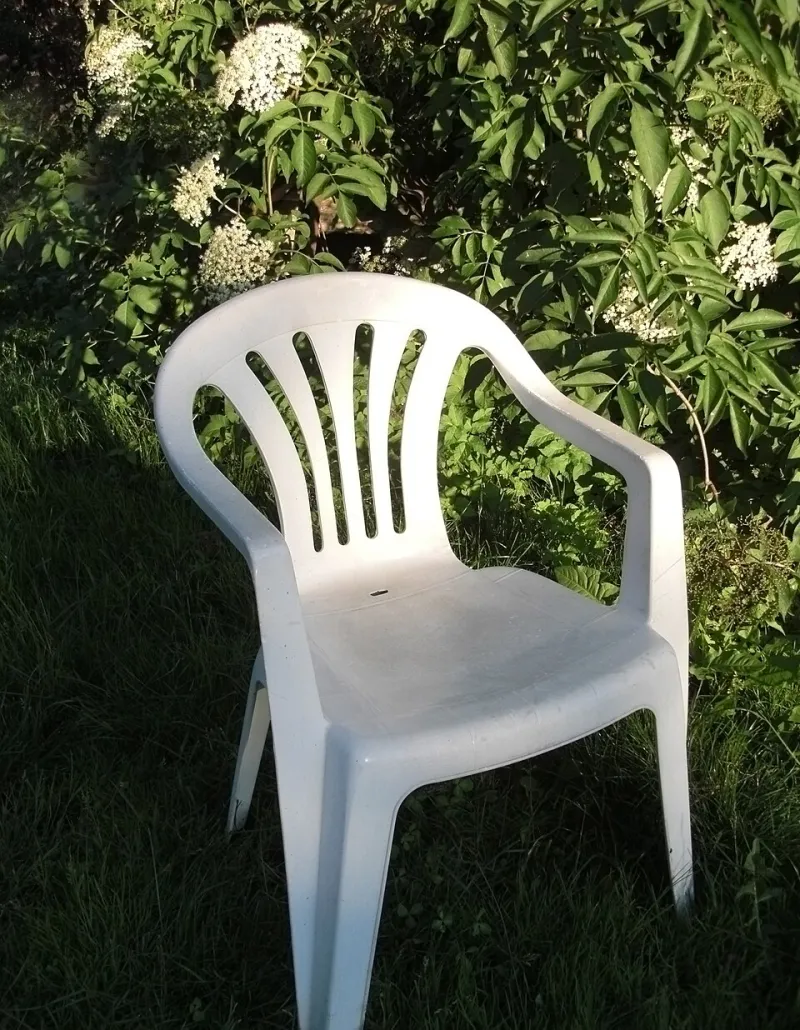
Photo: Seniju, CC BY 2.0, via Wikimedia Commons
It has no logo, no spokesperson, and no origin story worth a documentary — except that there is, in fact, a documentary. It has been photographed on every continent that has sidewalks. It has held up a bride in Manila, a grandmother in Lagos, a philosophy student in Buenos Aires, and roughly nine hundred thousand people at outdoor cafés from Ho Chi Minh City to Naples.
It is the monobloc chair. And it is almost certainly the most-owned chair in human history.
The Object Itself
One piece. Molded plastic — polypropylene, usually. Something like four pounds, armrests with a small hole drilled through so rain doesn’t pool in them, four legs that stack into a tower you could climb. Available in white, and in any other color if you are willing to wait for a shipment.
It is not beautiful in the way design magazines mean the word. It is beautiful in the way a paperclip is beautiful: it does exactly one thing, does it everywhere, and costs so little that you forget it is there.
A Very Short History of a Chair Without an Author
The monobloc is a child of postwar plastics and 1960s optimism, when designers genuinely believed that molding a single object out of one material was the future of everything. In 1968, the French designer Henry Massonnet produced a one-piece molded stacking chair sold cheaply to the public — a genuine landmark, and one of the objects that pointed at what was coming.
Through the 1970s and 80s, improved polypropylene and cheaper injection molding turned the idea into a commodity. By the 1990s, factories in Asia, Turkey, and southern Europe were producing them at volumes that made individual authorship irrelevant. The monobloc as we know it — the anonymous, slightly wobbling, ubiquitous chair — was never really “designed” by any single person. It was a shape that survived a hundred small manufacturing optimizations and then simply never stopped being manufactured.
Which is why design historians get a little misty about it. It is the rare case of an object that the world collectively refined without ever agreeing on a name for it.
How It Conquered the Planet
There is no reliable count. Estimates run in the billions produced, which means there are probably more monobloc chairs on Earth than there are people who have ever thought about monobloc chairs.
The conquest happened through pure logistics. A folding wooden chair is heavy, expensive, and dies in the rain. A monobloc stacks thirty high, weighs nothing, survives a monsoon, and costs less than two coffees. For a restaurant owner in Bangkok, a wedding planner in Punjab, a church in São Paulo, or a school in rural Kenya, that is not a design preference. That is the entire budget conversation, resolved.
So it appears everywhere at once. Sidewalk cafés in Rome and Hanoi. Roadside barbers. Political rallies, where the color of the chair sometimes matches the color of the candidate. Family reunions in backyards on four continents. Funerals, because grief needs somewhere to sit. The plastic seat in the corner of a hotel room that nobody uses but everybody recognizes.
Its strangest quality is that everyone thinks it is local. In Sicily it is the chair of the piazza. In Mexico City it is the chair of the tianguis. In Nigeria it is the chair of the party. In Ohio it is the chair on the porch that has been sun-bleached to a color not found in nature. A truly global object, it turns out, becomes invisible enough to be adopted as homegrown.
The Case Against
Let us be fair to the haters, because there are many, and some of them are correct.
Polypropylene does not enjoy sunlight. Leave a monobloc outside for a few summers and it goes chalky, then brittle, then dramatically unfaithful — a leg gives out while your uncle is mid-sentence. Broken ones get stacked behind buildings and stay there for decades. Some towns have tried to ban them from historic squares; letters to the editor get written; the chairs return anyway.
Then there is the aesthetic complaint, usually phrased as “eyesore,” which is really a complaint about class and public space dressed up as taste. The monobloc is cheap, and cheap things are visible, and visible cheap things make people uncomfortable.
The Case For
Here is the counterargument, and it is stronger than it sounds.
Some design critics — Alice Rawsthorn among them — have argued that the monobloc deserves serious attention as one of the significant objects of modern life, precisely because it solved a real problem for an enormous number of people at a price almost nobody else could match. A chair for four dollars is not a design failure. It is seating for a family that needed somewhere to put eight guests.
The monobloc is also a useful lesson in what design actually is. We are trained to believe design means a signed object, a name, a museum plinth. The monobloc is design as infrastructure: invisible, unglamorous, and load-bearing for ordinary life. There is now a well-traveled documentary about it, and the chair has appeared in more exhibitions than its anonymous factory floors ever intended.
And there is something genuinely delightful about an object that refuses to be owned. No brand can claim it. No nation can. It belongs to whoever is sitting on it, which is usually somebody waiting for someone else to finish talking.
Sit Down Anyway
So the next time you lower yourself onto one of these chairs at a café and it flexes slightly in a way that makes you consider your life choices, take a moment. Somebody in a factory optimized that flex. Somebody else shipped it in a stack of thirty. Somebody bought it for almost nothing and put it outside, and it has since held up a birthday, a eulogy, a first date, and a conversation that changed somebody’s mind.
The world’s most popular chair has no author, no marketing, and no dignity. What it has is a seat, and it has been saving one for you this whole time.