Your Great-Grandmother's Pantry Is Going Absolutely Viral Right Now
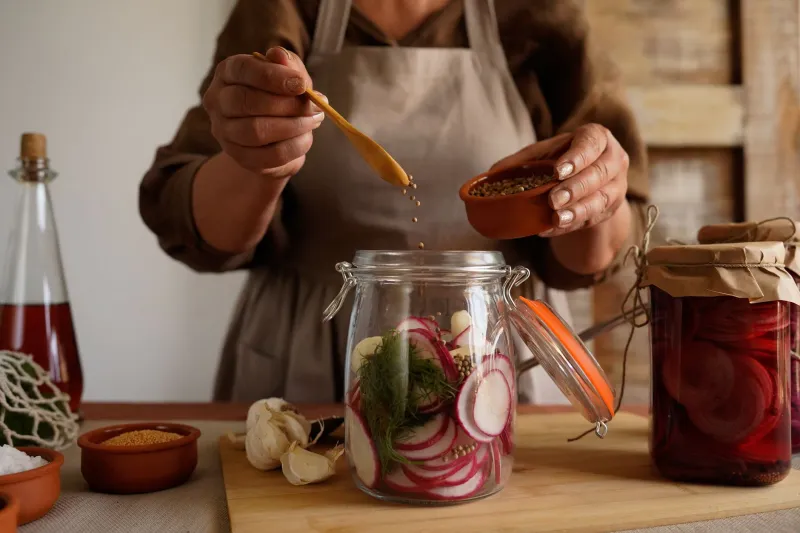
Somewhere between the ninth avocado toast trend and the fourteenth iteration of birria tacos, something quietly strange happened to American food culture. People started looking backward. Not to the 1990s — that nostalgia train has already made several stops — but way back. Pre-industrial back. Pre-grocery-store back. Back to a time when your great-grandmother knew what to do with a whole pig, a jar of brine, and a handful of grain varieties that most modern Americans can't pronounce.
Emmer. Einkorn. Teff. Kefir grains. Beef tallow. Fermented black garlic. These aren't items from a Whole Foods fever dream — they're ingredients that fed civilizations for thousands of years, fell out of fashion somewhere around the invention of the TV dinner, and are now racking up millions of views on platforms built for fifteen-second attention spans.
Welcome to the great food resurrection. Pull up a chair. There's heritage grain porridge.
The Algorithm Meets the Amphora
It started, as most cultural earthquakes do, with a handful of obsessives. Food historians who'd been shouting into the void for years. Small-batch farmers growing grain varieties that nearly went extinct. Fermentation nerds who turned their apartments into science experiments and documented every bubble.
Then the cameras found them.
Creators like Joshua Weissman, Internet Shaquille, and a sprawling ecosystem of 'ancestral eating' accounts began demonstrating that cooking from scratch — really from scratch, like render-your-own-lard from scratch — was not only possible but genuinely satisfying in a way that meal kit delivery services never quite managed to replicate. The videos are hypnotic: slow, deliberate, full of the kind of process that modern convenience has spent a century trying to eliminate.
And the numbers are wild. A video of someone making sourdough from a 4,000-year-old Egyptian starter strain? Seventeen million views. A TikTok on how to properly use beef tallow for roasting vegetables? Comments full of people saying things like 'my grandmother did this and I thought she was just being old-fashioned.' Turns out grandma was ahead of the curve.
The Ingredients That Came Back From the Dead
Heritage Grains: The Grain Renaissance Nobody Saw Coming
For most of the twentieth century, wheat meant one thing: the high-yield, fast-growing varieties engineered after World War II to feed a hungry planet. They did the job. They also, many argue, gave us a food system optimized for quantity over everything else — flavor, nutrition, digestibility, the ability to actually taste a piece of bread and feel something.
Heritage grains — einkorn, emmer, Red Fife wheat, Bloody Butcher corn — were the varieties that came before. Slower to grow, lower yield, harder to mill, and apparently: significantly more interesting to eat. Bakers who've switched report that bread made with ancient wheat varieties has a depth of flavor that modern flour simply can't replicate. It's the difference between a photograph of a sunset and an actual sunset.
Small mills across the Midwest and the South are experiencing a genuine renaissance, supplying an increasingly enthusiastic customer base that learned about their products not from a food magazine but from a twenty-two-year-old in Portland making content about 'eating like a Roman soldier.'
Fermentation: The Original Preservation Flex
Kimchi and kombucha are old news at this point — they've been at Trader Joe's long enough to feel mainstream. But the fermentation revival has gone considerably deeper than that. We're talking kvass (a fermented beverage made from bread that's been popular in Eastern Europe for a millennium), tepache (a lightly fermented pineapple drink from Mexico), and jun tea (a honey-and-green-tea ferment that sounds like it was invented by a medieval apothecary, because it basically was).
The appeal is partly health-adjacent — the gut microbiome conversation has been going strong for several years now and fermented foods are its obvious heroes. But it's also tactile and slow in a way that feels genuinely countercultural in 2024. You cannot rush fermentation. The bacteria do not care about your schedule. There's something almost radical about a food process that requires patience as a primary ingredient.
Animal Fats: The Villain Redemption Arc of the Century
Lard had a rough twentieth century. Demonized by the low-fat movement, replaced by partially hydrogenated vegetable oils that turned out to be considerably worse for human health, and exiled from the American kitchen for decades, it is now staging one of the most improbable comebacks in culinary history.
Food creators are documenting the process of rendering lard from scratch with the reverence usually reserved for religious ceremonies. 'My abuela used this for everything,' reads a comment under one such video, sitting at 2.3 million views. 'I feel like I'm reconnecting with something.' Beef tallow, duck fat, chicken schmaltz — the fats our great-grandparents kept in jars by the stove and used until they ran out are back, and they brought receipts.
What We're Actually Hungry For
It would be easy to dismiss all of this as aesthetic nostalgia — the food equivalent of buying a record player when Spotify exists. And there's certainly some of that happening. 'Cottagecore' as a visual language has absolutely influenced the way heritage food gets photographed and presented online. The linen backdrop. The ceramic crock. The artfully rustic loaf. These are choices.
But the hunger underneath the aesthetic is real, and it's worth taking seriously.
For a generation that grew up with unprecedented food convenience and unprecedented food anxiety — about ingredients, about processing, about the distance between farm and fork — there's something genuinely grounding about understanding where food comes from and how it was made before industrial optimization entered the picture. It's not anti-progress, exactly. It's more like... a desire to hold both things at once. The modern world and the knowledge that existed before it.
There's also a quiet grief in it. Many of the people making and watching these videos are reconnecting with techniques they never learned because the chain of transmission broke somewhere in the twentieth century. A grandmother who knew how to ferment vegetables, who rendered lard, who grew einkorn — and then convenience culture arrived, and the knowledge seemed unnecessary, and then one day it was gone.
The viral food revival is, in part, a community project to recover what was lost. One sourdough starter, one heritage grain porridge, one jar of homemade kvass at a time.
Your great-grandmother would probably find the TikTok part very confusing. But she'd be pleased about the lard.